
Strength
There’s strength in numbers. The IAM is 600,000 members strong and fighting every day to improve our jobs.
Security
You can’t put a price tag on peace of mind. Unions assure our jobs are secure and protect us against undue punishment.
Voice
IAM members sit down with their managers and negotiate over wages, benefits and more. That’s having a voice on the job.
WHAT’S AN AUTHORIZATION CARD?
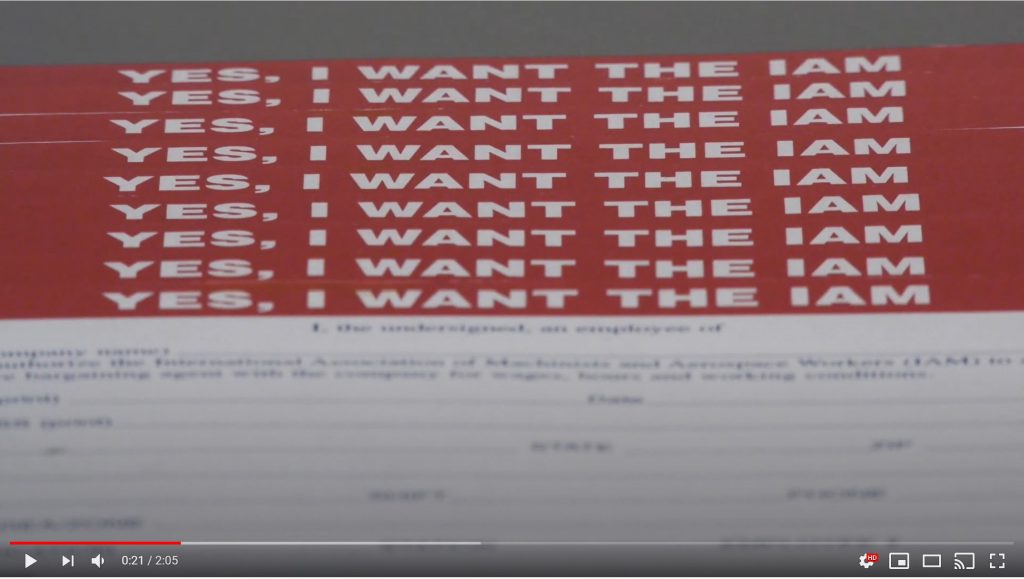
Collecting authorization cards is the process on how we get to a union election. It’s how we know there’s a genuine interest in forming a union. Signing a card does not mean you joined the Union. Don’t let management scare you with misleading information about the authorization card. They win and provide themselves even more control over the workforce if they can stop folks from controlling their own signature. Take a moment and watch a short video explaining the authorization card.
IAM Members Live Better
The International Association of Machinists & Aerospace Workers (IAM) represents roughly 600,00 workers across North America. That includes healthcare, aerospace, air and rail transport, manufacturing, distribution center and public-sector workers – just to name a few.
Learn More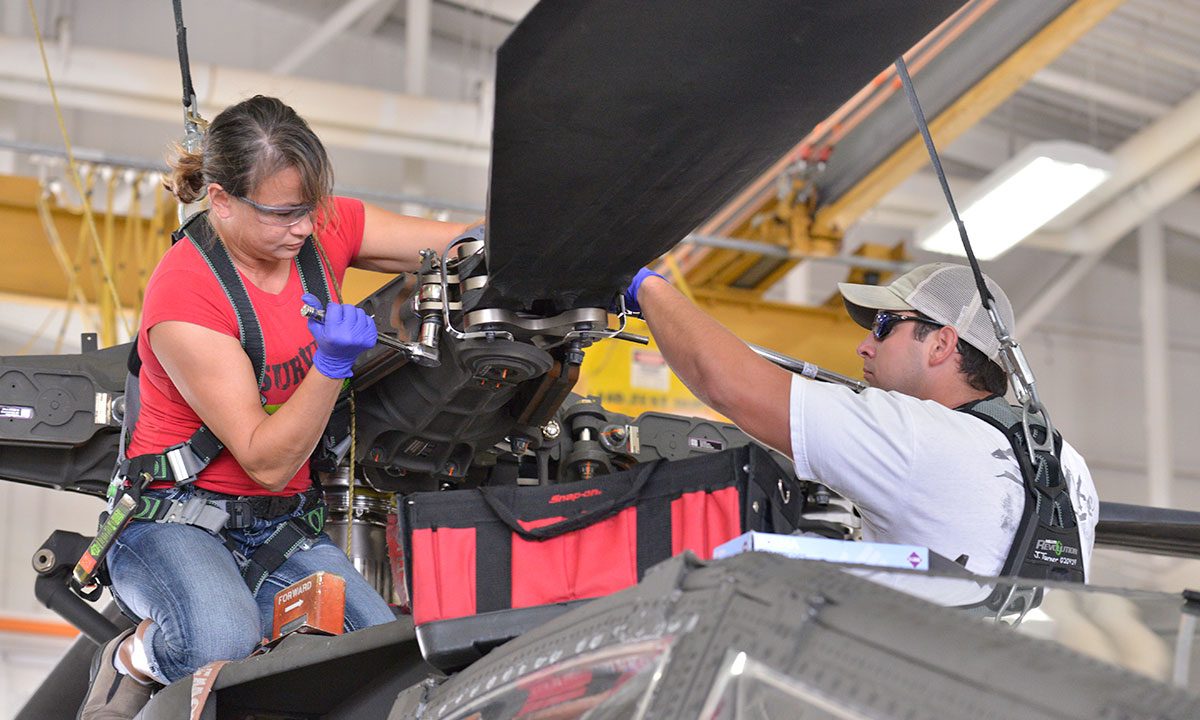

The Benefits of Belonging
More Money
Union members earn roughly $200 more every week than non-members. But it’s so much more than that. It’s about negotiating with your bosses over set wage increases that can’t change at management’s whim.
Fairness
A union-negotiated contract puts rules in place that allow you to do your job without fear of retaliation or unjust treatment. If you feel those rules have been broken, you have the legal right to appeal through a grievance procedure. As a result, everyone is treated with respect.
Free College
The IAMAW Free College Benefit makes it possible for you and your family members to earn an associate degree completely online — for FREE.
Learn MorePaid Time Off
Some 87 percent of union workers have access to paid sick days, compared to 69 percent of non-union workers. Roughly 89 percent of union workers get paid vacation and holidays, compared to roughly 75 percent of non-union workers.
Your Rights Under the Law
Under the National Labor Relations Act (NLRA), you and your co-workers have certain rights when it comes to forming a union.
You have the right to form, join or assist a union.
You have the right to distribute union literature, wear union t-shirts, ask co-workers to sign authorization cards and discuss the union with co-workers on non-work time.
Supervisors and management are not allowed to spy on you, coercively question you, threaten you or bribe you regarding your union activity.
You have the right to organize a union to negotiate with your employer over your wages, benefits and other working conditions.
Your employer cannot prohibit you from talking about or soliciting for a union during non-work time (including before and after work or during breaks).
You can’t be fired, disciplined, demoted, or penalized for engaging in any of the above mentioned activities.
Source: NLRB.gov
Latest News
Follow the latest news regarding your organizing campaign.
Your Questions Answered
In this forum, we will continue to update questions and concerns, address the union buster’s tactics, and provide information to help you make an informed decision.
How Much Are Dues?
A: Dues are 2.5% of the average wage of the collective bargaining group.
Example: Average wage $25.00 x 2.5%= $62.00
Dues are monthly, everybody’s Dues are $62.00
Broken down – weekly $15.50 a week or $2.06 a day.
The union buster is trying to make it appear you may pay large sums more than someone else because of the misleading statement dues are 2.5% of “overall gross pay.” There is no union that bases dues on gross pay. It’s a flat out lie.
Will Our Contract Have a Union Security Clause?
A: It’s up to you. A security clause is what many term a “closed shop.” The legal term is actually “agency shop.” The truth is nobody ever has to be a union member or follow any internal rules in an agency shop. Everybody has the right to refuse membership and only pay financial core fees. Workers propose, and the employer agrees to a security clause. Individuals who wish to remain non-members will pay a fee for representation, many times equal to or slightly less than dues.
The objective of union security provisions is to ensure that the union exists and performs its function. The security clause typically becomes a proposal during negotiations when the membership in an open shop reaches a high percentage of union members (80%-90%) and agree by a majority that closing the shop would benefit not hurt their union. That’s because workers over time come to realize the work and costs that come with proper representation and management of a strong contract. There are many who feel those cost should be shared when everyone is reaping the benfits. The fact is the more of you who belong to the Union, the more strength you have when it comes to negotiating your wages, benefits and more. You should not be concerned about a security clause because the majority will gladly contribute through dues to have a healthy, powerful union.
Will We “Lose” During Negotiations?
A: NO! PH is required by law to bargain in good faith. That means demonstrating a sincere effort to compromise on proposals put forth by you and your negotiation committee. It would be illegal for them to cut your wages in retaliation for voting for the union. Therefore, everything stays the same until you vote to approve a contract. And keep in mind – YOU vote on the contract. So, you don’t have to vote for anything you don’t want. If they really thought you would bargain down your wages and benefits, why would they go to s uch extreme lengths to oppose the union?
Besides, this is about more than just wages and benefits. It’s about being treated fairly. What the union buster is saying by telling you things might get worse is that you can’t handle being a union. They have to know you can see the difference between Saegertown and Erie. That all the negative stuff isn’t happening in Erie or other IAM Parker Hannifin facilities. The reason is they can sit down and negotiate over issues that matter to them. Why would it be different in Saegertown?